Auguste Mercier
An Officer and a SpyAuguste Mercier, a general who served as Minister of War from 1893 to 1895, is portrayed as a senior architect and later defender of the military case against Alfred Dreyfus. His importance lies in the distance between the authority with which he invoked state security and the contrary evidence he was later shown to have received: at the Rennes trial, he continued to insist on Dreyfus’s guilt while presenting material whose reliability and interpretation were under challenge.
Identity and Position
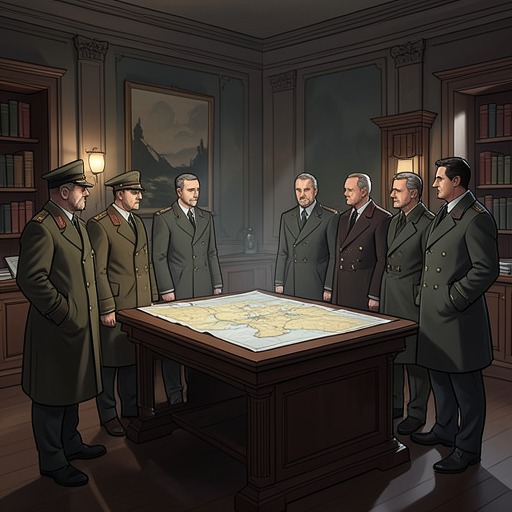
The book identifies Mercier as Minister of War during the years 1893–95. In an early meeting with Georges Picquart, he appears among the Ministry of War’s two most senior officers. The other is Raoul le Mouton de Boisdeffre, Chief of the General Staff; Mercier, then about sixty, is described as Boisdeffre’s superior. Their positions put Mercier at the junction of ministerial authority and the army’s handling of the case.
The meeting takes place in Mercier’s large, ornately panelled office, which opens onto a balcony above a snow-covered lawn. The setting places the discussion of Dreyfus within the formal space of government. Mercier’s manner is quiet, but the decisions he discusses have far-reaching consequences: he tells Picquart that Dreyfus must be placed somewhere he cannot communicate with others, either to send messages or to receive them. When Mercier points to a location on a globe on the coast of South America, Picquart identifies the penal colony at Cayenne. The exchange establishes isolation and the prevention of communication as explicit objectives of Mercier’s policy toward the prisoner.
The Case for Secrecy and Confinement
Mercier’s stated concern about messages leaving or reaching Dreyfus is consistent with the broader security rationale he later gives for the secret dossier. At the Rennes trial, he argues that the documents had to be shown to the judges at Dreyfus’s court-martial, and presents the danger of war with Germany as the context for that decision. He says he had believed the country to be close to war and that the court could not be left ignorant of the accusations. In his account, the closed nature of the trial did not solve the problem, because he did not trust secrecy to hold once the press became involved.
His explanation describes secrecy as both necessary and precarious: he says he sealed the documents and sent them to the president of the court-martial, while also maintaining that information from a closed proceeding would eventually reach the press. That reasoning offers a justification for excluding the defense from material used against Dreyfus, but also exposes the contradiction at its centre. Mercier presents disclosure to the judges as a matter of national necessity, even though the accused could not answer the secret material on equal terms.
Testimony at Rennes
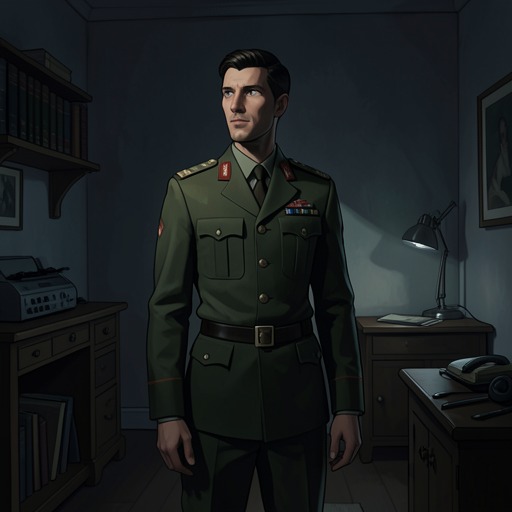
By the Rennes trial, Mercier is retired, but the narrative shows him resuming a leading role in the military cause. On the first Saturday when press and public are allowed back into the courtroom, he arrives in a general’s uniform with a black leather document case. He stands near Dreyfus but does not look toward him. His testimony lasts three hours, as he produces document after document, including the letter he treats as evidence against Dreyfus and fabricated reports attributed to Guénée. He omits the name Val Carlos, identified in the narrative as the source of those reports.
Mercier’s presentation also includes claims about money raised in England and Germany to secure Dreyfus’s release, and disputed allegations about Dreyfus’s views on Alsace-Lorraine and an earlier confession. He uses these claims to reinforce a case that rests not only on the contents of documents but on a wider portrait of conspiracy and disloyalty. In doing so, he brings the secret dossier’s material into open court. The narrative suggests that this creates an opportunity for the defense to challenge it, even as Mercier’s extended testimony gives the prosecution’s claims renewed prominence.
The confrontation becomes personal when Mercier acknowledges that a conscientious official can make mistakes, yet offers no actual retraction. Dreyfus rises in anger and insists that Mercier should admit his error. Mercier waits for the courtroom’s reaction to subside and answers that his conviction has not changed since 1894. He says his study of the secret dossier and the arguments made by Dreyfus’s supporters have strengthened it. He then closes his case and leaves to jeers. The scene sets the prisoner’s demand for acknowledgment against the general’s refusal to reconsider.
Evidence and Continued Denial
The testimony is especially compromised by information about the Italian telegram. In a later exchange, Georges Picquart tells Fernand Labori that the decrypt had been handed to Mercier personally. Labori concludes that Mercier must therefore have known, more than a month before the court-martial, that the letter he continued to cite could not refer to Dreyfus. The account emphasizes the disparity between Mercier’s access to that information and his decision to present the letter to the judges as evidence of guilt. At Rennes, he nevertheless continues to maintain his position.
During questioning by Edgar Demange, Mercier is asked about the falsified Panizzardi telegram in the Ministry of War archive. He denies knowledge of it. Asked why it was not included in the secret dossier shown to the court-martial, he answers that the French Foreign Ministry would not have liked it. Demange’s questioning, as portrayed by Picquart, does not press these answers effectively, and Mercier is soon allowed to leave the stand. The episode adds a second form of evasion to the earlier dispute: Mercier denies knowledge of the falsified telegram while offering an institutional reason for its exclusion.
Political Aftermath and Narrative Role
Mercier’s authority does not end with his ministerial tenure. At Rennes he is retired, yet the generals gather around him and the narrative presents him as once again leading the army’s cause. In January after Dreyfus’s release in September 1899, Mercier is elected senator for the lower Loire on a nationalist platform. The political outcome contrasts with the courtroom’s jeers: public hostility in one setting does not prevent his continued presence in national politics.
The character is presented primarily through Georges Picquart’s first-person account, which makes Mercier’s conduct visible through meetings, testimony, and exchanges in court rather than through access to Mercier’s private thoughts. That perspective supports a pointed contrast between his stated concern for security and his refusal to revise his judgment when contrary information is brought forward. Mercier’s role is therefore not simply that of a former minister recalling an old decision. He embodies the persistence of the official case: the documents remain in his case, the arguments return in public, and even the possibility of error does not alter his declared certainty.